






How to Choose a Plastic Pegboard Organizer Kit for Small Spaces
Release time: 2026-10-14
Table of Contents
The best pegboard organizer for a small space is not necessarily the largest kit or the one with the most accessories. It is the system that fits your available wall area, holds the items you use regularly, and can be installed securely.
A plastic pegboard organizer can help move everyday essentials off crowded desks, kitchen counters, and craft tables. However, choosing the right kit requires more than comparing colors and panel sizes. Mounting options, accessory compatibility, storage depth, and load limits all affect how well it works.
This guide explains what to check before buying and how to create a practical layout without overcrowding your room.
Start With What You Need to Store
Before choosing a panel, make a short list of the items you want to organize. This helps you avoid buying a kit filled with accessories that do not suit your routine.
For a Small Home Office
A desk-side pegboard can organize frequently used items such as:
- Pens and markers;
- Scissors;
- Charging cables;
- Lightweight headphones;
- Notes and small stationery supplies.
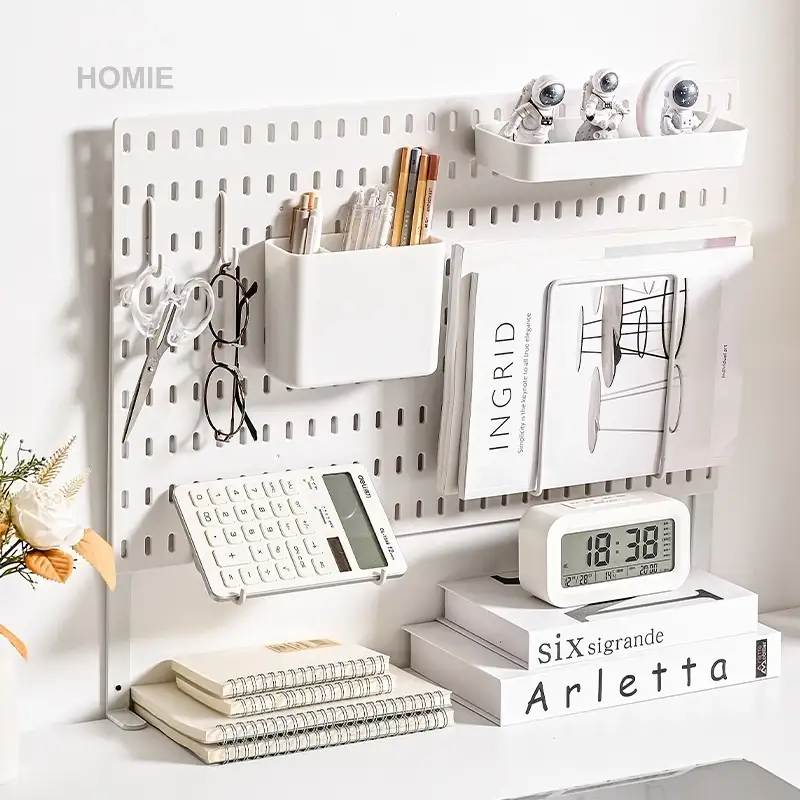
Prioritize cups, clips, and appropriately sized hooks. A shallow shelf may be useful, but check that it does not interfere with your monitor or working area.
For a Compact Kitchen
A kitchen layout might need hooks for lightweight utensils and small baskets for packaged items or accessories.
Consider where the board will sit in relation to cooking, washing, and food preparation. Follow the product’s guidance on heat and moisture exposure rather than assuming that every plastic panel is suitable beside a stove or sink.
For a Craft or Hobby Area
Craft storage often needs a combination of hooks, cups, and bins. Keep frequently used tools visible, and use containers for small pieces that cannot hang securely.
Choose the accessories around your supplies—not the other way around.
Measure the Complete Storage Footprint
Panel dimensions are only part of the space calculation. Hooks, baskets, and shelves extend into the room, so a board that fits the wall may still obstruct movement or access.
Check Width, Height, and Depth
Measure the available wall area, then check:
- Clearance above desks or countertops;
- Space needed to open doors and cabinets;
- Access to sockets, switches, and windows;
- The depth of the largest included accessory;
- Whether stored items will hang below the panel.
For example, a narrow panel may work above a desk, but a deep basket could reduce usable workspace.
Compare One Panel With a Modular Layout
A single panel can be enough for a few essentials. Modular systems offer more flexibility when you need to arrange panels vertically, horizontally, or in separate areas.
When evaluating a pegboard organizer kit for small spaces, check whether additional panels can be purchased later and whether they use the same accessories. Some plastic pegboard systems support tiled layouts, but expansion and compatibility are product-specific.
Choose a Mounting Method That Suits Your Wall
Installation is one of the most important buying considerations. The panel, fixings, wall surface, and stored items must work together as a complete system.
Adhesive Mounting
Some kits offer adhesive installation for specified surfaces and lighter loads. This can be convenient where drilling is not preferred, but it comes with limitations.
Before choosing an adhesive system, confirm:
- Approved wall surfaces;
- Surface preparation requirements;
- Waiting time before loading;
- Maximum permitted load;
- Removal instructions.
Do not assume that “no drilling” means “no risk of surface damage.” Removal results can depend on the adhesive, finish, and condition of the wall.
Screw Mounting
Screw-mounted systems require suitable fixings for the wall construction. Drywall, masonry, and timber may need different hardware.
Check whether the kit includes appropriate mounting components and whether spacers or brackets are required behind the panel. Some systems need clearance for accessory insertion, while others incorporate that clearance into their design.
Read the Load Rating Carefully
A panel’s advertised capacity should not be treated as the capacity of every hook or shelf.
Look for separate information about:
- Total panel load;
- Individual accessory load;
- Mounting conditions;
- Weight distribution;
- Any restrictions on adhesive installation.
Do not estimate capacity from how thick or rigid the panel looks.
Select Accessories by Function, Not Piece Count
A kit with many parts is not automatically better. A smaller set of useful accessories can make more effective use of limited wall space.
| Accessory | Useful For | What to Check |
|---|---|---|
| Short hooks | Lightweight tools and utensils | Hook shape, retention, and rated load |
| Longer hooks | Items with larger hanging loops | Projection depth and available clearance |
| Cups | Pens, brushes, and small hand tools | Opening size and cleaning access |
| Baskets | Loose supplies and small packaged items | Depth, attachment security, and load limit |
| Shelves | Small containers and frequently used items | Support points and permitted weight |
| Clips | Notes and lightweight flat items | Grip and ease of repositioning |
Check Accessory Compatibility
Pegboard accessories are not universally interchangeable. Hole diameter, spacing, slot shape, and attachment design can differ.
Before buying extra hooks or bins, confirm that they are approved for your chosen panel. A custom pegboard organizer kit should provide a clear list of included components and compatible additions, rather than relying on the word “universal.”
Build a Layout Around Everyday Access
A pegboard works best when items are easy to take out and put back. Filling every available hole can make the system harder to use.
Place Frequently Used Items Within Comfortable Reach
Keep everyday items where you can access them without stretching across furniture. Less frequently used supplies can occupy higher or less accessible positions.
Leave enough room around hooks and cups to remove items comfortably.
Group Similar Items
Create simple zones, such as:
- Writing and stationery;
- Cables and small electronics;
- Craft tools;
- Kitchen accessories.
Grouping related items makes the layout easier to understand and maintain.
Leave Space for Adjustments
Start with the essentials rather than installing every accessory immediately. After using the board, rearrange components according to what feels convenient.
Leaving some open space also makes it easier to accommodate new items without buying another panel.
When Is a Custom Pegboard Organizer Kit Worth Considering?
Customization can be useful when a standard bundle does not match your wall space or storage needs.
For household users, the most useful customization may be choosing a different mix of hooks, cups, and shelves. For retailers or project buyers, customization may also involve colors, packaging, or kit configurations.
Prioritize Practical Customization
Ask whether the supplier can provide:
- A panel arrangement that fits your space;
- An accessory mix suited to your intended use;
- Additional matching panels;
- Replacement hooks and mounting components;
- Clear installation and care instructions.
A custom color can improve the appearance of a room, but it should not take priority over safe installation and useful accessories.
Confirm the Final Specification
Before ordering, check the exact panel dimensions, accessory quantities, mounting method, and load guidance.
If purchasing in bulk, also confirm sample approval, minimum order quantity, packaging, and delivery terms. “Customizable” does not necessarily mean that every feature can be changed.
Common Mistakes to Avoid
Buying More Accessories Than You Need
Unused parts add clutter rather than reducing it. Choose a kit based on the items you actually plan to store.
Ignoring Storage Depth
A shelf or basket can fit the panel while still getting in the way of a desk, doorway, or cabinet.
Assuming All Walls Support the Same Installation
Use the mounting method and hardware appropriate to both the product and the wall surface.
Treating All Accessories as Interchangeable
Confirm hole patterns and attachment compatibility before purchasing additions.
Organizing Without Checking Weight
Small items can add up. Consider the combined weight of the accessories and their contents, and follow the stated installation limits.
A Simple Buying Checklist
Before choosing a kit, make sure you can answer these questions:
| Question | Why It Matters |
|---|---|
| Does the full layout fit the available space? | Prevents interference with furniture and movement |
| Are the included accessories useful? | Avoids paying for unnecessary components |
| Is the mounting method suitable for the wall? | Supports dependable installation |
| Are load limits clearly stated? | Helps prevent overloading |
| Can matching accessories be added later? | Makes the system easier to expand |
| Are parts easy to clean and replace? | Supports continued everyday use |
The right kit should create more usable space, not simply add another storage feature to an already crowded room.
Frequently Asked Questions
What size pegboard is best for a small room?
Choose according to your available wall area and the items you need to store. Include the depth of hooks, shelves, and baskets in your measurements. A compact panel with a useful accessory mix may work better than a larger, crowded layout.
Can a plastic pegboard be installed without drilling?
Some systems offer adhesive mounting, but suitability depends on the product, wall surface, and load. Follow the installation instructions and do not assume that adhesive removal will leave every surface unchanged.
Can I use hooks from another pegboard brand?
Only if the hole pattern and attachment design are compatible. Check the specifications before buying, because accessories that look similar may not fit securely.
Is a larger accessory kit better value?
Not necessarily. Value depends on how many components you will use, whether they fit the panel, and whether the complete layout works in your space. Prioritize useful accessories over the total piece count.